December 14, 2012. A 20-year-old gunman named Adam Lanza invaded the Sandy Hook Elementary School in Connecticut and fatally shot 20 children, ages six and seven, and six adult staff members. Following that horrific event, the town of Newtown decided to build a new, 87,000-sf PreK-4 school, which required extreme sensitivity by the Building Team that worked hand and hand with the town on every aspect of the building’s planning, design, and construction.
On the recommendation of owner’s rep, STV|DPM, the school’s Public Building and Site Commission assembled the project team before planning began. The architects collaborated with more than 50 participants of the project’s programming committee. The Building Team also worked with teachers and parents to develop workshops to inform young children about the project’s design, engineering, and construction.
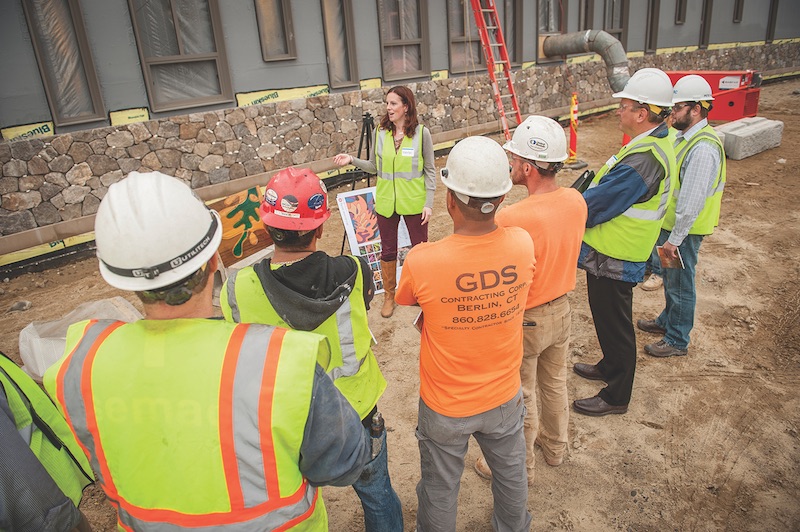 The Building Team went to great lengths to assuage a still-grieving community during the design and construction for this school. That included training sessions for subcontractors to reinforce the sensitive nature of this project. Robert Benson Photography.
To respect the community, the construction process closed off the site to gawkers, limited photography, and accommodated project tours for school staff members, families of survivors, and teachers. Construction manager Consigli hosted two subcontractor events to raise awareness among the trades about the project’s requirements.
The new school’s striking design emphasizes outdoor activities. Footbridges recall the geology of Newtown’s watercourses. The building’s largest central courtyard—overlooked by two small breakout spaces imagined as tree houses—is landscaped with two amphitheater-style classroom spaces for outdoor learning. The building’s light-filled main lobby includes a two-story wall of clear and colored glass and overhead corridor bridge, with nearby artwork evoking nature.
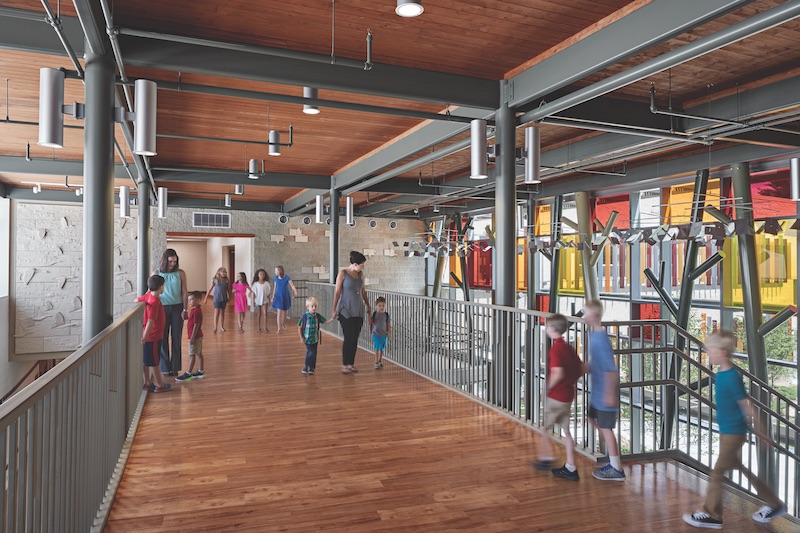 This finished product emphasizes outdoor activities and includes an overhead corridor bridge. Robert Benson Photography.
Building Team – Submitting firm, architect Svigals + Partners Owner Town of Newtown, Conn. Interior architect Lynn Brotman Interior Design Structural engineer Michael Horton Associates MEP BVH Integrated Services CM Consigli Constrution Owner’s representative STV|DPM
General Information – Size 87,160 sf Cost $39.8 million Construction time October 2014 to July 2016 Delivery method CM at risk
Interesting read originally from BDC Network
Comments
Post a Comment