About 1.5 million people visited the Boston Public Library between July 2016 and March 2017. That’s a 22% increase over what the library drew from July 2015 through March 2016.
That bump was attributable, in large measure, to the library’s $78 million renovation, the results of which debuted in July 2016. This three-year-long project, lead by William Rawn Associates | Architects and Consigli Construction, opened up and brightened what, by consensus, had been an uninviting space for patrons, disconnected from its Copley Square neighborhood.
The renovation—whose numerous accolades include, most recently, the 2017 Preservation Massachusetts, Paul and Niki Tsongas Award—achieved that goal in several ways.
Most notably, it created a 35-ft-wide, 210-ft-long connection between Johnson Hall—a building designed by architect Phillip Johnson and opened in 1972—and the McKim Building, designed by Charles McKim and opened in 1892. Johnson was on record saying that he was never satisfied with the way the entrance and lobby to his building turned out. Neither were visitors who often found themselves wandering through labyrinthine corridors to get from one part of the library to the other.
“People were always getting lost,” said Cliff Gayley, a Partner with William Rawn Associates, who with Sindu Meier, a Senior Associate of the firm; and Phil Brault, Senior Project Manager with Consigli, recently spoke with BD+C about their work on transforming the library.
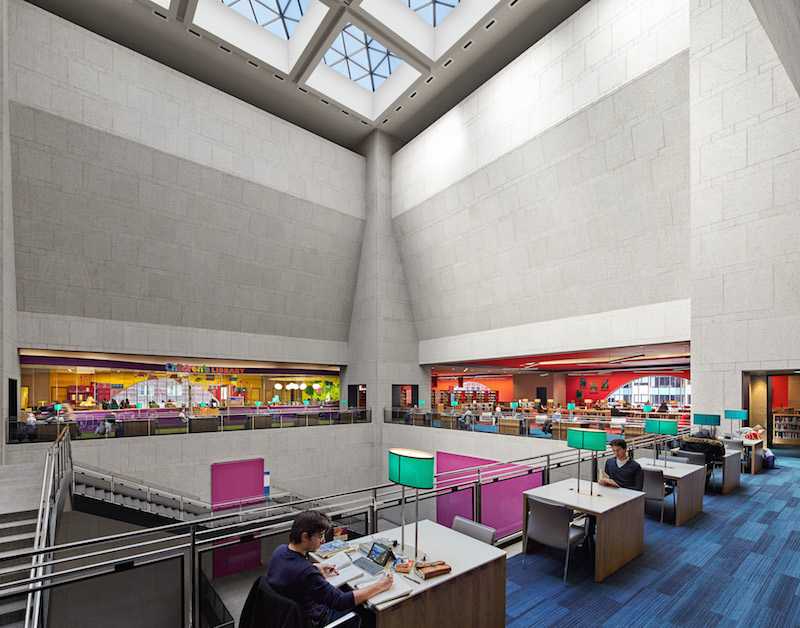 The second-floor renovation of Boston's Central Library doubled the size of the Children's library, and created quiet reading spaces around its periphery. The library's atrium, Deferrari Hall, provides ample natural sunlight. Image: Robert Benson Photography.
The master plan for this landmark library’s overhaul was drawn up in 2012, soon after which “it became clear very quickly that the building had been designed for a different time,” recalled Meier.
To create a more logistically elegant pathway between the two buildings, the Building Team needed to support the McKim Building’s load-bearing but fragile masonry wall with structural framing and shoring that could withstand a load of over 1 million pounds.
The team devised a steel framing system, preloaded with hydraulic jacks, which allowed for the removal of two concrete columns below the second floor that each handled a load of over 300,000 pounds.
The renovation also removed ugly tinted windows that offered virtually no outside view, as well as 97 granite plinths that formed a barrier around the Johnson building. In their place is a more amenable façade of two-story-high windows that, at ground level, is flush with the sidewalk, making the building appear more approachable from the street.
A movable tunnel system from Boylston Street allowed the library to stay open during construction. The Building Team hauled in building materials through second-floor windows during the renovation, which was conducted in two phases
The first, which was completed in February 2015, spruced up the second floor by doubling the size of the Children’s library, introducing a maker space for teenagers, and creating reading and classroom areas around the perimeter.
Phase two, completed in the summer of 2016, revitalized the lower floor’s Kirsten Business Library and Innovation Center. The entrance to the newly created two-story Boylston Hall offers a Welcome Center and circulation desk (moved back about 75 feet from the door, said Gayley), with informational touch screens that, among other things, allow visitors to peruse the library’s digital catalog.
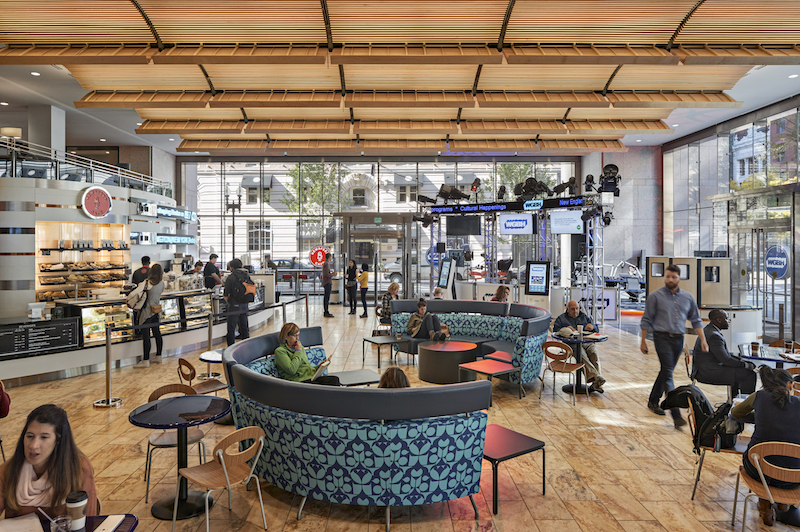
The newly created Boylston Hall leads visitors to a glass-enclosed area with a cafe and a satellite studio for WGBH. It was important to library officials that the renovation include a retail component. Image: Robert Benson Photography
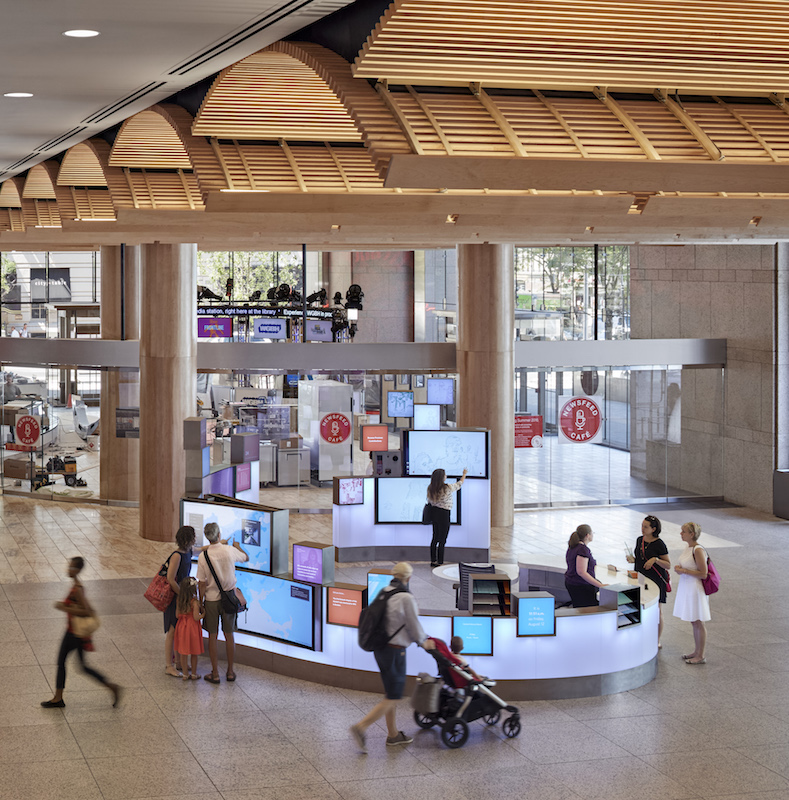 A Welcome Center at the library's entrance offers a digital experience to visitors. Image: Robert Benson Photography
That Boylston Street entrance, encompassed by glass, leads visitors to the library’s Newsfeed Café, managed by Catered Affair; as well as a “new and novel” section for fiction and nonfiction, and a satellite television studio for WGBH, Boston’s public station. “Libraries are struggling to remain relevant, and this project exhibits forward thinking and entrepreneurship,” observed Brault. A fetching curved wood-slatted ceiling accents this area.
A total of 156,000 sf were added or improved by this renovation, which included making activities on each floor visible and transparent via Deferrari Hall, the Central Library’s striking atrium, which bathes its more-open and colorful spaces in natural light from the library’s roof.
Interesting read originally from BDC Network
Comments
Post a Comment